



Radial basis function (RBF) approximations for PDE problems
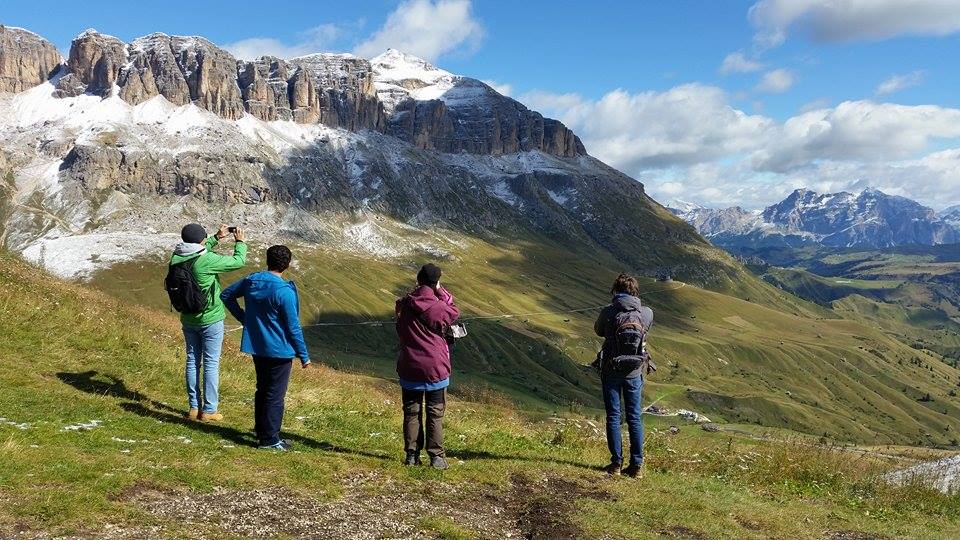
Members of the RBF research group documenting the view during the Dolomite Research Week on Approximation 2015. Photo: Alvise Sommariva.
The main focus of this project is to develop numerical techniques based on RBF methods that are stable, efficient and can be applied to real application problems. We are particularly interested in high-dimensional applications because of their extreme demands.
What is RBF approximation
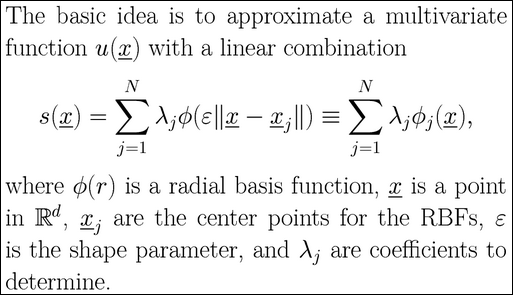
The picture below is an example of how the RBFs can be visualized in a two-dimensional computational domain. Six weighted radial basis functions, drawn as red surfaces in the picture, are scattered over the computational domain. Their sum build up the interpolant, represented by the transparent surface with wireframe.
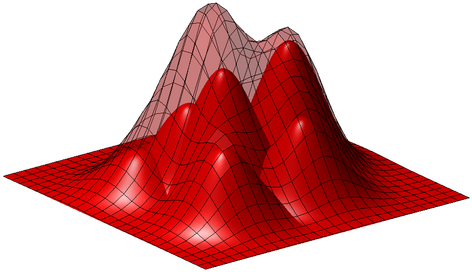
The main advantages of the RBF method are
- The method is meshfree, which means that it is flexible with respect to the geometry of the computational domain. It also means that the method is suitable for problems where data is only available at scattered points.
- The method is not more complicated for problems with many space dimensions, since the only geometrical property that is used is the pairwise distance between points.
- For smooth functions, approximations with smooth RBFs can give spectral convergence.
Master thesis projects
We regularly offer subjects for MSc thesis projects. Please consult our list of available projects. You may also contact us directly to discuss alternative topics.
Current directions of research
Biomechanical simulation of the respiratory muscles
The focus is put to the simulation of the diaphragm, the main muscle of the respiratory system. The underlying model is based on the equations of nonlinear elasticity which are solved on a realistic 3-dimensional geometry using RBFs.
Numerical investigations and theory concerning the limit where the RBFs become flat. This limit is interesting because it can produce very accurate results for smooth functions and it reproduces multivariate polynomial interpolation.
Software
Various RBF codes, mostly in MATLAB are collected under the RBF software page.
 The Research Group Enjoying the weather Mar 2022 The Research Group Enjoying the weather Mar 2022 |
|---|
Publications
Refereed publications
Consolidated list of group publications (also including some non-RBF topics)PhD and Licentiate theses
-
Oversampled radial basis function methods for solving partial differential equations
 . Ph.D. thesis, Digital Comprehensive Summaries of Uppsala Dissertations from the Faculty of Science and Technology nr 2142, Acta Universitatis Upsaliensis, Uppsala, 2022. (fulltext
 , preview image).
 -
Global radial basis function collocation methods for PDEs. Licentiate thesis, IT licentiate theses / Uppsala University, Department of Information Technology nr 2020-002, Uppsala University, 2020. (fulltext).
-
Radial Basis Function generated Finite Difference Methods for Pricing of Financial Derivatives. Ph.D. thesis, Digital Comprehensive Summaries of Uppsala Dissertations from the Faculty of Science and Technology nr 1702, Acta Universitatis Upsaliensis, Uppsala, 2018. (fulltext, preview image).
-
Localised Radial Basis Function Methods for Partial Differential Equations. Ph.D. thesis, Digital Comprehensive Summaries of Uppsala Dissertations from the Faculty of Science and Technology nr 1600, Acta Universitatis Upsaliensis, Uppsala, 2018. (fulltext, preview image).
-
Radial basis function methods for pricing multi-asset options. Licentiate thesis, IT licentiate theses / Uppsala University, Department of Information Technology nr 2016-001, Uppsala University, 2016. (fulltext).


Supervised BSc and MSc theses
-
Patch-Local Coupled Quadrature for Galerkin RBF-PUM: Construction, Assembly, and Robustness. Student thesis, supervisor: Elisabeth Larsson, examiner: Jörn Zimmerling, IT mTBV 26 013, 2026. (fulltext).
-
Extending the Unfitted RBF-PUM to Time-DependentPDEs for Option Pricing. Student thesis, supervisor: Elisabeth Larsson, examiner: Jörn Zimmerling, IT mTBV 26 011, 2026. (fulltext).
-
An Investigation of the Viability of Quadrature-Based Localized Galerkin-RBF Methods for PDE Problems . Student thesis, supervisor: Elisabeth Larsson, examiner: Davoud Mirzaei, IT mTBV 25 014, 2025. (fulltext).
- Igor Tominec, Parallel localized radial basis function methods for the shallow water equations on the sphere, Technical University Munich, 2017. (Advisors: E. Larsson and H.-J. Bungartz) (Link: http://user.it.uu.se/~bette/IT_MasterThesis_final.pdf )
-
Discretization of the Dirac delta function for application in option pricing. Student thesis, supervisor: Lina von Sydow, Elisabeth Larsson, examiner: Martin Sjödin, TVE nr 16 067 juni, 2016. (fulltext).
-
Numerical methods for option pricing under the CGMY process. Student thesis, supervisor: Josef Höök, Lina von Sydow, examiner: Tomas Nyberg, Elisabeth Larsson, UPTEC F nr 15014, 2015. (fulltext).
-
Evaluation of a least-squares radial basis function approximation method for solving the Black-Scholes equation for option pricing. Student thesis, supervisor: Elisabeth Larsson, examiner: Lina von Sydow, Jarmo Rantakokko, IT nr 12 051, 2012. (fulltext).
-
Adapting a Radial Basis Functions Framework for Large-Scale Computing. Student thesis, supervisor: Elisabeth Larsson, examiner: Jarmo Rantakokko, IT nr 12 050, 2012. (fulltext).
-
Parallelizing a Software Framework for Radial Basis Function Methods. Student thesis, supervisor: Martin Tillenius, Elisabeth Larsson, examiner: Michael Thuné, Anders Jansson, IT nr 11 084, 2011. (fulltext).
-
Designing a Flexible Software Tool for RBF Approximations Applied to PDEs. Student thesis (Master Programme in Computational Science), supervisor: Elisabeth Larsson, Martin Tillenius, examiner: Michael Thuné, Anders Jansson, IT nr 10 058, 2010. (fulltext).
- Björn Rodhe, A discontinuous Galerkin method with local radial basis function interpolation, UPTEC Report F 07 066, School of Engineering, Uppsala University, 2007. (Advisors: E. Larsson and S.-E. Ekström)
- Andreas Hall, Pricing financial derivatives using radial basis functions and the generalized Fourier transform, UPTEC Report IT 05 036, School of Engineering, Uppsala University, 2005. (Advisors: E. Larsson and K. Åhlander)
- Gunnar Marcusson, Option pricing using radial basis functions, UPTEC Report F 04 078, School of Engineering, Uppsala University, 2004. (Advisors: E. Larsson and L. von Sydow)
- Ulrika Pettersson, Radial basis function approximations for the Helmholtz equation, UPTEC Report F 03 082, School of Engineering, Uppsala University, 2003. (Advisor: E. Larsson)
Current RBF research group members
- Elisabeth Larsson, Professor, Dept. of IT, Scientific Computing, Uppsala University.
- Lina von Sydow, Professor, Dept. of IT, Scientific Computing, Uppsala University.
- Davoud Mirzaei, Associate Professor, Dept. of IT, Scientific Computing, Uppsala University.
- Andreas Michael, M.Eng., Ph.D. student, Dept. of IT, Scientific Computing, Uppsala University.
 Research group at Katalin, Feb 2011 Research group at Katalin, Feb 2011 |
 In the Dolomites, Sep 2015 In the Dolomites, Sep 2015 |
|---|
Former RBF research group members
Still collaborators, but at a longer distance.
- Alfa Heryudono, Ph.D., Dept. of Mathematics, University of Massachusetts, Dartmouth, MA, USA (visiting researcher jun 2010-aug 2011).
- Ali Safdari-Vaighani, Ph.D., Allameh Tabatabai University, Tehran, Iran (visiting Ph.D. student 2011).
- Cecile Piret, Ph.D., Applied Mechanics and Mathematics (MEMA), Université Catholique de Louvain (UCL), Belgium (visiting researcher jul 2012-sep 2012).
- Erik Lehto, Ph.D., Numerical Analysis, KTH Royal Institute of Technology, Stockholm (PhD from Uppsala University 2012).
- Martin Tillenius, Ph.D., Machine games, Uppsala (PhD from Uppsala University in 2014).
- Ahmad Saeidi, Iran University of Science and Technology, Tehran, Iran (visiting PhD student 2015).
- Jamal Amani Rad, Ph.D., Shahid Beheshti University, Tehran, Iran (visiting PhD student 2015).
- Victor Shcherbakov, Ph.D., SEB, Stockholm (PhD from Uppsala University in 2018).
- Slobodan Milovanovic, Ph.D., Boston Consulting Group, Stockholm (PhD from Uppsala University in 2018).
- Katharina Kormann, Associate Professor, Dept. of IT, Scientific Computing, Uppsala University.
- Bostjan Mavric, Researcher, Dept. of IT, Scientific Computing, Uppsala University.
- Ulrika Sundin, M.Sc., Ph.D. student, Dept. of IT, Scientific Computing, Uppsala University.
- Igor Tominec, M.Sc., Ph.D. student, Dept. of IT, Scientific Computing, Uppsala University.
- Bengisen Pekmen Geridönmez, Visiting Associate Professor, TED University, Ankara, Türkiye.
- Fatemeh Pooladi, Visiting Ph.D. student, Persian Gulf University, Bushehr, Iran.
Contact
For more information contact Elisabeth Larsson.